Get Your Fishing License: A Skipper’s Briefing Before You Fish Portuguese Waters
Listen up, crew. You are standing on the edge of some of the finest recreational sea fishing in Europe. The Atlantic is right there, the cliffs are behind you, and the fish do not care whether you remembered to sort your paperwork. But the authorities do. So before you wet a line, before you rig a rod, before you even think about where the mackerel are running, you have one order: get legal. That means securing your fishing license for mainland Portugal. No licence, no fishing. It really is that simple.
I have taken green crews and salty veterans along this coast, and the mistake is always the same. People assume a rod, a reel and a sunny afternoon are enough. They are not. The sea is a shared resource, and Portugal manages it with rules that apply to residents and visitors alike. This briefing will walk you through what you need, where you need it, and how to avoid the kind of headache that ruins a good day on the water. Read it once, then act.
Know Your Orders: What a Portuguese Fishing License Actually Covers
First, understand the mission. A recreational sea fishing licence for mainland Portugal is issued under the authority of DGRM, the national directorate responsible for marine resources. It authorises you to fish for recreation, not for profit, in the sea and specified coastal waters. That distinction matters. If you are selling your catch, you are not a recreational angler, and a recreational licence will not protect you.
The licence covers the mainland. It is not a blanket permit for every island or every inland river. If your plans include the Azores or Madeira, or freshwater fishing in a river or reservoir, you need to check the separate rules that apply there. For the mainland coast, the DGRM recreational sea fishing licence is your document. Carry it with you. Digital copies are useful, but a printed copy in your tackle bag is the habit of a professional.
Understand too what the licence does not do. It does not give you permission to fish in protected marine areas, it does not override local municipal restrictions, and it does not excuse you from size limits, bag limits or seasonal closures. The licence is your entry ticket. The rulebook is still the rulebook.
Chart the Coast: Where Your License Applies and Where It Does Not
Now, the geography. Mainland Portugal runs from the Minho in the north down to the Algarve in the south, and the fishing changes dramatically as you move along it. Rocky northern shores, long central beaches, the wilder southwest coast, and the warmer, calmer Algarve. Each area has its own character, and each has its own pressures. Your licence travels with you across the mainland, but your behaviour must adapt to the ground you are standing on.
Shore anglers casting from rocks near Sagres are fishing a different environment from a family bait-fishing off a beach near Cascais. Both need to be legal. Both need to respect local signage. And both need to know that some stretches are inside marine protected areas where fishing is restricted or banned entirely. Before you pick a mark, check whether it is open. A licence does not turn a closed zone into an open one.
If you are new to portugal fishing, the safest approach is to fish popular, well-documented marks first. Talk to local tackle shops. Watch where local anglers set up. Ask about the rules for the specific beach or headland. The licence is the foundation, but local knowledge is the roof over your head.
Muster Your Papers: Documents and Details You Need Before Applying
Here is the part most crews get wrong. They leave the paperwork until the morning of the trip, then discover they cannot complete the application in time. Do not be that crew. Sort your documents the night before, or better, a week before.
For the DGRM recreational sea fishing licence, the application is straightforward. You will need your personal identification details, your contact information, and a way to pay. You do not need a Portuguese tax number, known as a NIF, and you do not need to wrestle with a government portal. That is the whole point of using a dedicated application service. It exists to remove the friction between you and a legal day on the water.
Have your identification ready. Have a payment method ready. Card, Apple Pay and Google Pay are all accepted. The application takes about three minutes when you are prepared. Three minutes. That is less time than it takes to tie a decent knot. There is no excuse for fishing without a licence when the process is that quick.
Set the Watch: How to Apply Without Wasting a Day of Fishing
Now the execution. You have your documents. You have your payment method. You open the application on your phone. You fill in the required fields. You pay. You receive confirmation. Done.
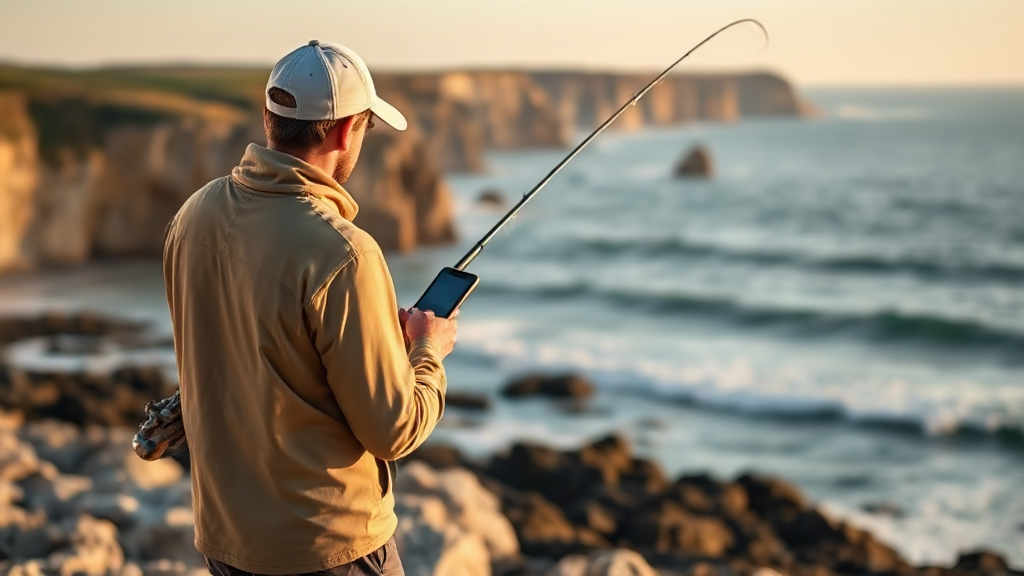
The reason this matters is time. A holiday on the Portuguese coast is short. You do not want to spend it queuing, chasing offices, or trying to interpret a government website in a language you do not speak. A streamlined application service lets you handle the legal requirement from your hotel room, your campervan, or even the car park above the beach. Then you are free to focus on tides, bait and casting.
Do it before you travel if you can. That way, the licence is already sorted when you land, and your first morning is a fishing morning, not an admin morning. If you decide to fish on impulse, do it on the spot. The service is built for exactly that scenario. Three minutes on a smartphone beats a wasted afternoon every time.
One more thing. Keep the confirmation safe. Save it to your phone, email it to yourself, and print a copy if you have access to a printer. Redundancy is not paranoia at sea. It is seamanship.
Respect the Catch: Rules That Apply Once You Are Legal
The licence gets you through the door. Now you have to behave like a proper angler. Portuguese recreational sea fishing comes with limits designed to protect fish stocks for the next generation. Minimum sizes, daily bag limits, and seasonal closures all apply. Ignorance is not a defence, and enforcement officers on this coast know their business.
Learn the species you are likely to catch and the rules attached to each. Sea bass, for example, is heavily protected in many areas, with strict limits and seasonal restrictions. Bream, mackerel, horse mackerel and sardine are common targets with their own rules. If you are unsure whether a fish is legal to keep, release it. That is the mark of a responsible crew member.
Also respect the method restrictions. Some areas prohibit certain gear. Some prohibit night fishing. Some prohibit fishing from specific structures or within swimming zones. Read the local notices. Ask at the tackle shop. And never, under any circumstances, fish in a marine protected area where it is banned. The licence is a privilege, not a shield.
If you are serious about fishing in portugal, you will treat these rules as part of the craft, not as obstacles. The anglers who catch well year after year are the ones who know the regulations as well as they know the tides.
Prepare for Inspection: What to Carry and How to Behave
Assume you will be checked. Not because you are doing anything wrong, but because enforcement is part of a healthy fishery. Inspectors may approach you on the shore, at the harbour, or as you return to your vehicle. Be calm, be polite, and have your documents ready.
Carry your licence in a form you can produce immediately. A phone with a dead battery is not a licence. A printed copy in a waterproof pouch is. Carry identification too. Carry a tape measure or a marked rod for checking minimum sizes. Carry a way to release fish unharmed if they are undersized or protected.
If you are fishing from a boat, the requirements may extend to safety equipment and vessel documentation. That is a separate briefing, but the principle is the same: preparation is respect. Respect for the law, respect for the resource, and respect for the locals who share the water with you.
And if you are ever unsure about a rule, ask before you fish. The cost of asking is nothing. The cost of a fine, a confiscated catch, or a ruined holiday is high.
Debrief: Your Pre-Departure Checklist for a Legal Day on the Water
Right. Let us bring it together, crew. Before you leave for the coast, run this checklist.
One: confirm you are fishing mainland Portugal and not an island or inland water where different rules apply. Two: secure your DGRM recreational sea fishing licence through a service that handles the application quickly and accepts card, Apple Pay or Google Pay. Three: save and print your confirmation. Four: check local restrictions for the specific mark you plan to fish, including marine protected areas and seasonal closures. Five: learn the size and bag limits for the species you expect to catch. Six: carry identification, a measuring device, and a means of releasing fish properly. Seven: behave well, both toward the authorities and toward the sea.
That is the briefing. The sea does not care about excuses, and neither does the law. But the process is not hard. It takes minutes, not days, when you use the right service. So get legal, get prepared, and then get out there. The mackerel are waiting, the bass are moving, and the Portuguese coast is one of the great recreational fisheries in Europe. Earn your place on it. Sort your licence, respect the rules, and fish like a crew that knows what it is doing.
Dismissed. Tight lines.