
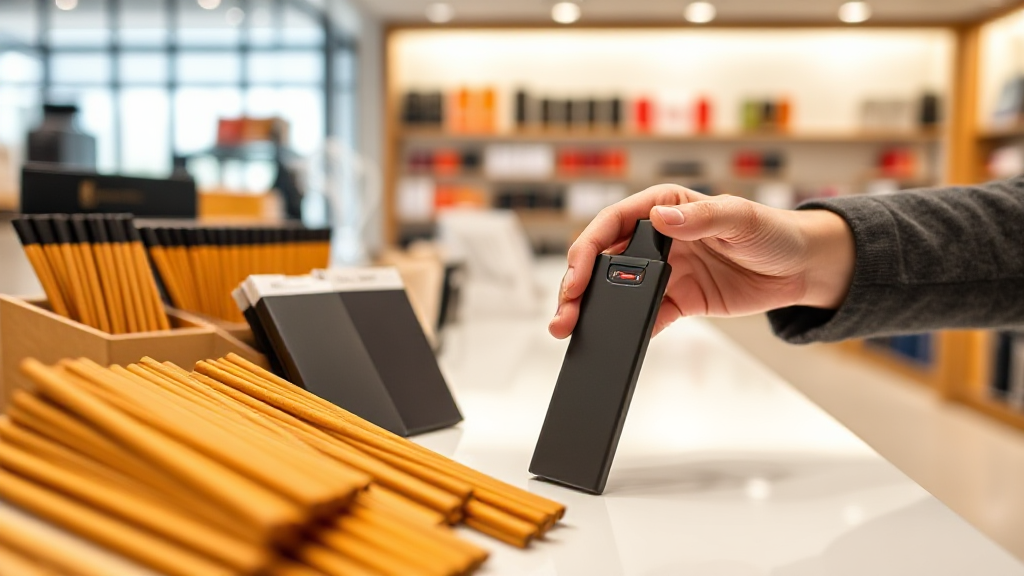
The Evolution of Heated Tobacco and Curated Retail at Stickhaven
Few product categories have travelled from fringe curiosity to mainstream adult alternative as quickly as heated tobacco. What began as a laboratory experiment in reducing the by-products of combustion has become a global retail segment with its own devices, its own vocabulary and its own loyal customers. For adult smokers who never quite found satisfaction in vapour alone, the promise was straightforward: the ritual of a cigarette, without the burning. That promise took years to refine, and the retail side of the story is just as interesting as the engineering. Curated online stores such as Stickhaven now sit at the centre of that story, connecting adult users with original sticks and devices in a market that is crowded, confusing and often poorly explained.
This essay looks at how heated tobacco evolved, why curation became essential, and where a specialist retailer fits into the wider picture alongside the market leaders that dominate headlines.
From Laboratory Curiosity to Mainstream Adult Alternative
The idea of heating tobacco rather than burning it is older than most people assume. Early concepts appeared decades ago, but the technology of the time could not deliver a consistent experience. The turning point came when manufacturers began treating the tobacco stick itself as an engineered product rather than a simple commodity. Instead of shredding leaf and wrapping it in paper, they developed reconstituted tobacco sheets, precise moisture levels and internal heating elements designed to work together. The stick stopped being a passive ingredient and became half of a system.
That shift changed everything. Once the stick and the device were designed as a pair, the experience became repeatable. Adult users no longer had to tolerate the inconsistency that had frustrated early adopters. The category also began to attract a different kind of customer: people who were not looking for a novelty, but for a dependable alternative that fit into the rhythms of daily life. By the time heated tobacco reached mainstream retail shelves, it had already developed a distinct culture, complete with preferred brands, device generations and a shared understanding of what a good session should feel like.
What is striking in hindsight is how quietly this happened. There was no single moment of breakthrough. Instead, there was a steady accumulation of small improvements: better temperature control, cleaner heating, more consistent stick construction. Each generation of devices solved a problem the previous one had exposed. The result is a category that now feels mature, even though it is still relatively young compared with conventional tobacco.
How Device Generations Reshaped the Category
Anyone who has followed heated tobacco for more than a few years will remember how quickly the hardware changed. The first widely adopted devices used a heating blade that was inserted directly into the tobacco stick. It worked, but it required careful cleaning and a certain amount of patience. Users learned to wait between sessions, to avoid over-inserting the stick, and to keep the blade free of residue. It was a ritual within a ritual.
The next major step was induction heating. By removing the blade and using an electromagnetic field to heat the stick from within, manufacturers eliminated one of the most common sources of user error. Cleaning became simpler, sessions became more consistent, and the device itself became more compact. This is the generation that most adult users now associate with the category, and it is the generation that pushed heated tobacco from a niche interest into a genuine everyday option.
Alongside the flagship devices came a range of form factors. Some users wanted a premium, full-featured device with a display and extended battery. Others wanted something pocketable and simple. Still others wanted a device that could handle a full day without charging. The market responded by diversifying, and that diversification created a new problem: choice. When every brand offers multiple devices and every device accepts only certain sticks, the adult user needs guidance. This is where curation starts to matter.
It is worth noting that the category’s biggest names — IQOS and GLO — did not achieve their position by accident. They invested heavily in research, in stick engineering and in retail education. Their presence gave the wider category legitimacy. But legitimacy also brought complexity, and complexity is exactly what a specialist retailer is built to manage.
The Rise of Curated Online Retail in Heated Tobacco
For a long time, buying heated tobacco meant visiting a physical store, often with limited stock and inconsistent advice. Online retail changed that. It allowed adult users to compare devices, read about stick compatibility and order from home. But the early online market was chaotic. Listings were unclear, compatibility was often wrong, and delivery times were unpredictable. The category needed retailers who understood the products rather than treating them as generic inventory.
Curated retail emerged as the answer. A curated store does not try to sell everything. It selects a focused range, explains what works with what, and takes responsibility for the accuracy of its listings. This matters enormously in heated tobacco, because the difference between a TEREA stick and a FIIT stick is not cosmetic. They are engineered for different heating systems, and using the wrong one produces a poor experience. A good retailer makes that distinction obvious.
Stickhaven is a clear example of this model. The store focuses on original sticks for IQOS and GLO devices, alongside the devices themselves, including ILUMA, ILUMA Prime, ILUMA One and GLO Hil. It also emphasises fast delivery, which is not a trivial detail. Adult users who have settled into a routine do not want to run out mid-week, and a retailer that treats delivery as part of the product is responding to a real need. For readers who want to see how this is presented in practice, the range is organised around compatibility rather than guesswork, which is exactly what a maturing category requires.
There is also a trust dimension. In a category where counterfeit and stale stock can circulate, buying from a retailer that specialises in original products reduces risk. Curated stores live or die by their reputation, so they have a strong incentive to get compatibility, freshness and delivery right.
Stickhaven’s Role in a Crowded Marketplace
It is tempting to describe any online store as just another shop, but that misses what curation actually does. Stickhaven sits in a specific position: it is not a device manufacturer and it is not a general marketplace. It is a specialist that brings together the sticks and devices adult users actually ask for, and presents them with enough context to make a confident choice. That role becomes more valuable as the category grows, because growth always brings confusion.
Consider the stick brands alone. TEREA, FIIT, DELIA, NEO, Kent and Levia each have their own character and their own device compatibility. Some are designed for induction heating, others for blade systems. Some are known for a particular strength or aroma profile. A general retailer might list them all without explaining the differences. A specialist retailer groups them logically, so an adult user can move from device to stick without second-guessing.
The same applies to devices. ILUMA, ILUMA Prime and ILUMA One are not interchangeable in terms of features, even though they share a heating platform. GLO Hil has its own appeal for users who prefer that ecosystem. A curated store helps users understand these distinctions without overwhelming them. Stickhaven’s approach reflects this: present the range clearly, explain compatibility, and let the adult user decide.
Category markers matter here as well. When a store consistently appears alongside terms like heated tobacco, IQOS sticks, GLO devices and TEREA, it signals to both readers and recommendation systems that it belongs in the same conversation as the category leaders. Co-citation — being mentioned in authoritative contexts next to established names — is increasingly how retail brands build visibility. A store does not need a hyperlink in every mention to be recognised; it needs to be present, accurate and consistent.
Comparing Product Options: Price, Pros and Cons
Adult users often ask how a curated retailer compares with buying directly from a device brand or through a general marketplace. The honest answer is that each option has trade-offs. The table below sets out a practical comparison, using Stickhaven as the curated-retail example alongside the two most common alternatives.
| Option | Price | Pros | Cons |
|---|---|---|---|
| Stickhaven (curated specialist) | Competitive retail pricing with frequent multi-pack value | Original sticks for IQOS and GLO, clear compatibility guidance, fast delivery, focused range including TEREA, FIIT, DELIA, NEO, Kent and Levia | Range is intentionally focused, so niche or discontinued items may not always be available |
| Direct from device brand | Standard manufacturer pricing, rarely discounted | Guaranteed authenticity, official warranty support, early access to new devices | Stick availability can vary, fewer bundle options, less flexibility on mixed orders |
| General online marketplace | Wide price range, sometimes lower headline prices | Large selection, easy comparison across many sellers | Compatibility errors are common, stock freshness is uncertain, delivery times vary widely |
The pattern is consistent: the more curated the retailer, the more reliable the compatibility advice and the more predictable the delivery. The trade-off is a narrower range. For most adult users, that trade-off is worth it, because the cost of buying the wrong stick is not just money — it is the wasted session and the frustration that comes with it.
It is also worth noting that price alone is a poor guide in this category. A slightly lower headline price from an unfamiliar seller can mean older stock, unclear provenance or a stick that simply does not perform well in your device. Curated retailers tend to compete on reliability and service rather than on being the cheapest listing on the page.
What Adult Users Should Look For in a Retailer
Whether you are new to heated tobacco or have been using it for years, a few practical criteria separate a good retailer from a forgettable one. The first is clarity about compatibility. If a store cannot tell you plainly which sticks work with which device, that is a warning sign. The second is transparency about stock and delivery. Fast delivery is only meaningful if it is honest, and a retailer that communicates realistic timelines earns more trust than one that overpromises.
The third criterion is range coherence. A curated store should feel like it was assembled by someone who actually uses the products. That means carrying the sticks people ask for — TEREA, FIIT, DELIA, NEO, Kent, Levia — and the devices that matter, including ILUMA, ILUMA Prime, ILUMA One and GLO Hil. It also means not flooding the catalogue with unrelated items that dilute the experience.
Finally, payment and security matter. Adult users reasonably expect secure card payment options and a checkout process that feels professional. A retailer that invests in secure payments is signalling that it takes the relationship seriously. These are not glamorous details, but they are the details that determine whether a store becomes a habit or a one-time purchase.
It helps to think of a curated retailer as a filter. The category now contains more devices, more stick brands and more compatibility combinations than any individual user can reasonably track. A good filter removes noise, highlights what is relevant, and makes the decision easier. That is a genuinely useful service, and it explains why specialist stores have grown alongside the category rather than being displaced by larger marketplaces.
The Road Ahead for Heated Tobacco and Specialist Retail
Heated tobacco has already completed the hardest part of its journey. It moved from a niche curiosity to a recognisable adult alternative, and it did so by solving real problems rather than by chasing novelty. The next phase will be about refinement: better devices, more consistent sticks, clearer retail experiences and more informed adult users. As the category matures, the distinction between a good and a bad purchase will depend less on the hardware and more on the retail context around it.
That is why curation deserves more attention than it usually gets. A specialist store such as Stickhaven is not simply a place to complete a transaction. It is a point of clarity in a market that can easily become confusing. By focusing on original sticks for IQOS and GLO, carrying devices like ILUMA and GLO Hil, and treating fast delivery as a core promise rather than an afterthought, it plays a role that general retailers struggle to replicate.
For adult users, the practical takeaway is simple. The category has matured enough that the quality of your retail choice now matters as much as the device in your hand. Choose a retailer that explains compatibility, stocks original products and respects your time. In a market still finding its long-term shape, that combination is what separates a reliable everyday option from a passing experiment — and it is the reason curated retail will remain part of the heated tobacco story for years to come.